Myofunctional Therapy in Batavia, IL: Help for Tongue Thrust, Mouth Breathing & More
If your child's dentist mentioned a "tongue thrust," their pediatrician brought up mouth breathing, or you've noticed your own jaw popping and clicking at night — you may have already heard the term myofunctional therapy. Here's what it actually is, who it helps, and what treatment looks like at The Lucky One Speech, Language, and Learning, proudly serving Batavia, Geneva, St. Charles, North Aurora, Aurora, and the rest of the Fox Valley.
What Is Myofunctional Therapy?
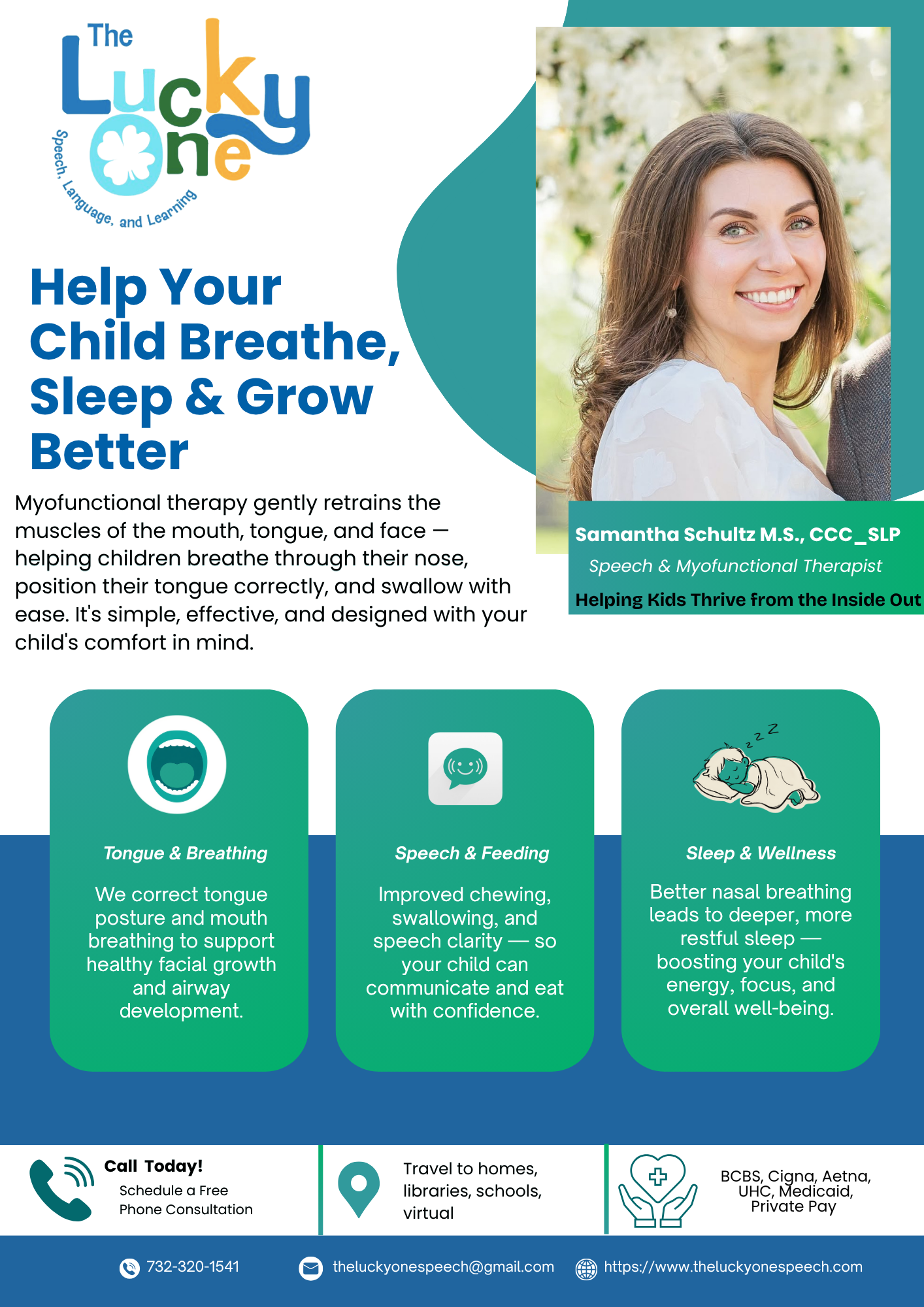
Myofunctional therapy — also called orofacial myofunctional therapy (OMT) — retrains the muscles of the mouth and face to move, and rest, the way they're supposed to. Rather than focusing on teeth or jaw structure directly (that's your dentist or orthodontist's job), myofunctional therapy targets the muscle patterns behind breathing, chewing, swallowing, and speech: where the tongue rests, whether the lips seal at rest, and whether a person breathes through the nose or the mouth.
It's typically provided by a speech-language pathologist with specialized training, often working alongside a child's dentist, orthodontist, or ENT as part of a coordinated care team.
Signs You or Your Child Might Benefit
In children, common signs include:
Resting with lips apart and mouth open, rather than closed
Tongue thrust — the tongue pushes forward between the teeth during swallowing
Breathing through the mouth instead of the nose, including during sleep
Drooling past the age most kids have outgrown it
Speech sounds that are hard to understand, especially /s/ and /z/ sounds ("thlush" for "slush")
A tongue that rests forward, low, or between the teeth instead of up on the roof of the mouth
In teens and adults, it's often:
Jaw clenching or teeth grinding
Jaw pain or clicking (TMJ symptoms)
Snoring or other sleep-disordered breathing
Chronic mouth breathing
Speech sound patterns left over from childhood that never fully resolved
None of these signs on their own means something is "wrong" — but together, they're worth a conversation.
What Does Myofunctional Therapy Actually Treat?
Orofacial muscle patterns don't just affect speech. Left unaddressed, they're associated with:
Mouth breathing and poor nasal airflow
Tongue thrust and related speech sound errors
Prolonged thumb-, finger-, or pacifier-sucking habits
Dental and orthodontic relapse (teeth drifting back out of alignment after braces)
Sleep-disordered breathing, including pediatric snoring and obstructive sleep apnea
TMJ disorders and jaw tension
Recovery and habit retraining after a tongue-tie release (frenectomy)
What To Expect in Treatment
Myofunctional therapy is active, hands-on, and practiced daily — not something that happens only at appointments. Depending on age and goals, sessions may include:
Targeted tongue, lip, and cheek exercises to build strength and awareness
Breathing retraining to encourage nasal breathing
Swallowing pattern retraining
Speech sound work, when tongue placement is affecting articulation
Short daily home exercises between sessions to build new muscle habits
A full course of therapy generally runs several months to about a year, since the goal isn't just doing the exercises correctly in the room — it's making the new pattern automatic in daily life. Myofunctional therapy is generally appropriate starting around age 4, once a child can understand and follow specific instructions, and works well for teens and adults too.
Serving Batavia and the Fox Valley
The Lucky One Speech, Language, and Learning PLLC is based right here in Batavia, IL, and proudly works with families throughout the Fox Valley — including Geneva, St. Charles, North Aurora, Aurora, Elburn, Sugar Grove, Oswego, and surrounding Kane County communities. If a dentist, orthodontist, or pediatrician in the area has mentioned tongue thrust, mouth breathing, or an orofacial myofunctional concern, we're a local resource ready to help.
A Note on This Article
This article is educational information, not a diagnosis. If you have concerns about your child's (or your own) breathing, swallowing, or speech patterns, the next best step is an evaluation with a qualified provider — we'd be glad to be that resource, or to help you find the right one.
Ready to find out if myofunctional therapy is a fit? Contact The Lucky One Speech, Language, and Learning to schedule a consultation.
Sources: American Speech-Language-Hearing Association, Orofacial Myofunctional Disorders Practice Portal;Cleveland Clinic, "Myofunctional Therapy".